A child smiling after an exam. A hug at the end of a visit. A nervous patient leaving the office skipping. “Every time I tell a child that their body is okay, every time that they smile after they finish, every time that they skip out of my office after an exam, every time that I get a hug from a child, those are the moments,” she said. “As long as they’re okay, I’m okay.”
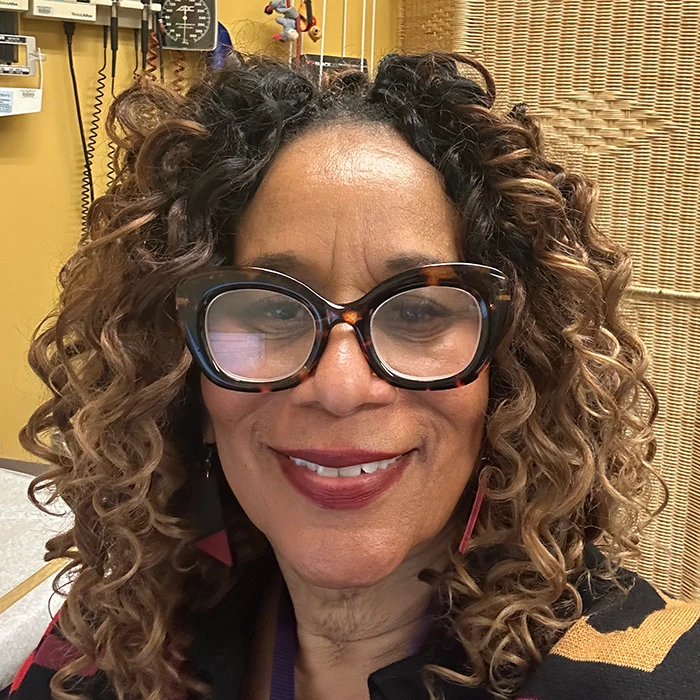
Over the years, it has been the children themselves who have reaffirmed that calling again and again. For two decades, Dr. Adine Latimore has stood beside children and families at some of the most difficult moments of their lives. Through her work with the Pediatric Sexual Assault Nurse Examiner Program (Pedi SANE), she has helped young patients move through fear, uncertainty, and trauma with care that is both clinically sound and deeply compassionate.
When she first saw the opportunity to train as a nurse practitioner in this work, something about it immediately felt different.
“I was working in primary care pediatrics, and I was thinking this was a different opportunity to help children in a very special way,” Latimore said. “That I could help them get through that trauma was enough to get me out of primary care into something more specialized, and something where I felt that I could do more.”
That perspective shapes every part of how Latimore approaches her role. For her, trauma-informed care means more than clinical excellence. It means listening carefully, believing children and parents, and making sure care is delivered in a way that helps rather than harms.
She knows that while children are often remarkably resilient, parents and caregivers are carrying their own pain, guilt, and fear. Part of her work is creating space for that too, meeting families with steadiness and reassurance while guiding them through an unfamiliar and overwhelming process.
What Latimore wants children and families to leave with is simple but profound: this experience does not define the rest of their lives.
“I want the families and the children to feel that what has happened to them does not determine what’s going to happen for the rest of their lives,” she said. “They will heal. They can be productive. They can laugh. They can play. Their bodies are okay.”
That reassurance is not abstract. In her exam room, Latimore helps children understand their own bodies, often giving language and clarity to parts of themselves that have been shrouded in secrecy or fear. She wants them to leave not only with answers, but with a renewed sense of safety and ownership over their bodies.
Over 20 years, Latimore has also witnessed enormous growth in the Children’s Advocacy Center network and in the Pedi SANE response across Massachusetts. She remembers when only a handful of CACs had pediatric SANEs. Today, that reach has expanded significantly, along with hospital partnerships, statewide coverage, and new tools like tele SANE services that have transformed access to expert care.
For Latimore, that growth reflects a larger shift in awareness. More people are talking openly about child sexual abuse, and more systems are recognizing the importance of specialized, child-centered responses. At the same time, she is candid about the work that remains. Maintaining and strengthening programs like Pedi SANE requires constant education, sustained support, and a commitment to ensuring children and families feel seen and represented.
“One challenge we still have is that people don’t know about the CACs until they have to use one,” she said. “Another challenge we have still is that we have very few people of color to respond to cases, especially when we have a large population of Black and brown kids who are seen.”
That commitment to visibility and belonging is something Latimore takes seriously in her own practice. In her office, she intentionally creates an environment where children know they are welcome, safe, and accepted exactly as they are.
“We need to do better,” she said. “I have signs in my room, like everybody’s welcome. I have flags in my room. I’ve always had Black and brown books, LGBTQ+ materials in my room, because these are kids and they’re going through change and we need to be accepting.”
Asked what has kept her motivated after so many years, Latimore’s answer returns once again to the children. “Just the kids. Just to make a difference. Just to know that I have served someone and I have made their life a little bit better,” she said. “Most of them heal mentally and physically. Those kind of things keep me focused.”
Latimore also sees MACA’s growth through the leadership and advocacy that have helped strengthen the statewide response over the years. She points to the organization’s steadfast focus on children, its support for CACs and frontline providers, and its willingness to fight for the funding and policy changes needed to sustain the work.
“There’s never a doubt in my mind that MACA is going to do what it can so that everyone gets justice and all the kids get justice,” she said. “MACA’s job is to make sure we have the supports in place for these kids and their families. As long as we keep that focus, they will be there right with us, fighting for whatever it is.”
Even after 20 years, Latimore says she cannot imagine walking away from this work. If anything, her conviction has only deepened.
“It’s still a wonderful job,” she said. “These kids need support, and we need folks to really support them and be there for them and not forget who they are. We want to continue to be supporters of them and stay in the fight.”
Through every exam, every reassurance, every listening ear, and every child who leaves feeling safer than when they arrived, Latimore continues to show what it means to pair clinical expertise with compassion. Her work is not only about responding to trauma. It is about helping children and families believe in healing, in dignity, and in the possibility of moving forward.